

How to Read People Even Though They’re Not Books
In this article series, I explore how Relationship Friction and Relationship Wisdom shape career satisfaction and progression through apparently innocuous, yet critical, workplace moments.
For those of you unfamiliar with these two core concepts in my framework, let me point you to:
Relationship Friction Breaks Careers as well as
5 Signs that Relationship Friction is Stalling Your Career and finally
How Relationship Wisdom Fuels Your Career Progress
Today, I will address the misconception that we can read other people. People are not books. The good news: if you ask the right questions and actually listen, people will reveal themselves to you.
Let’s approach this from the following four angles:
Some people are sure they can’t read others
Other people are sure they can read others
What to make of body language and non-verbal cues
How to realistically read others
Some people are sure they can’t read others
“But I can’t read people”, she protested.
Caroline[1] sighed and shifted uncomfortably in her chair.
This session had been about preparing her for a networking event the following week.
An important occasion to both meet new potential clients and reconnect with existing ones.
She had attended the preceding conference a year ago and the 4 days had been “torture”.
What could she do differently this time around to make the most of this business opportunity?
And so, naturally, we got talking about how to ‘read the room’.
Which Caroline was sure she couldn’t do.
She shared stories of being incapable of sussing out people in social and professional contexts.
Here is what this otherwise highly-competent high-flyer had tried so far:
When her lack of spontaneity unsurprisingly made for awkward pauses in conversations,
Cringe.
She knew it hadn’t gone down well.
Here is what we unpacked in terms of how she likely came across to others as a result:
 Not a good look.
Despite tremendous effort.
Her preoccupation with social failure meant that Caroline could no longer experience conversation with a stranger as a natural exchange. Instead, she was absorbed both before and during with what looked like running hundreds of background calculations on her expected and actual performance.
I was surprised there wasn’t smoke coming out her ears.
Her self-assessment was biased: she recalled only the uncomfortable moments. I detected that she was blowing those up and, in contrast, discounting any positive response. For example, she interpreted someone pausing before answering as a sign of disinterest when her interlocutor might have simply been taking the chance to reflect before replying to her.
She would leave those group occasions deflated. She had failed to connect and her sense of distance fed not just her original belief that she “can’t read people” but also fed the adjacent belief that there was “something wrong with” her which made it impossible for her to fit in such environments.
Sadly, her “epic fail” had witnesses: colleagues witnessed her behaviour and, kind-hearted souls that they are, naturally made sure to discuss her embarrassment. Her standing had started to suffer.
An acute case of Relationship Friction if there ever was one.
Caroline was in tears.
I spoke to her softly: “People are not books. No wonder they can’t be read.”
She stared at me.
“Would you try to read a cassette tape?”, I asked
(She and I are old enough to have lived our teenage years creating mixed tapes)
She shook her head vigorously.
“A painting?”
More shaking.
Crucially: her face started to smile.
“A movie?”
The Relationship Wisdom pivot:
People are not texts to be decoded. They are people to be engaged with.
Other people are sure they can read others
Here is a story about Hector[2].
I remember him still because he was passionate, driven and uncompromising.
Picture us in a meeting with a few others.
Hector is presenting. He worked tirelessly on his deck. He wanted to impress and convince.
A colleague asked a clarifying question.
In a neutral tone.
How do I know? Well, I thought so but I later asked some of the other attendees.
Hector read it as a challenge.
He told me that this particular individual had been sceptical in the past.
So Hector went on the offensive.
He battled an insult rather than answering a genuine question.
We all sat there, watching an adversarial dynamic take form before our very eyes.
Hector left the meeting fuming.
He hadn’t gotten the buy-in he wished for.
In my view and several others’, the buy-in he deserved.
His new enemy killed his project.
Hector eventually resigned.
Crash and burn.
Hector and I discussed that fateful meeting over several lunches in the cafeteria.
I suggested that it was his combative response which had precipitated the crisis.
Hector would have none of it.
He was so sure he’d read the other person right.
Years later, studying psychology, I knew what had happened: Hector fell victim to his own projection.
Hector was someone who only pushed back when he was genuinely in disagreement.
He assumed others did too.
He thought everyone else operated the way he did.
Hector read any challenge as hostility.
Any question as disapproval.
He wasn’t reading anyone else but himself.
It cost him his career at a prestigious investment bank.
Be reassured: he found a new role. In fact, a series of new roles.
Let’s consider what might have been happening.
Hector thought he knew so he never checked. He treated his first impression as the only version of the truth. Because he read himself, he projected his own emotions and convictions onto others. Hector was an anxious individual, and I recall him experiencing our workplace as mostly hostile.
You probably won’t be surprised to read that Hector was impervious to feedback. He always knew better. And ignoring feedback had two unfortunate consequences: first, he missed out on identifying and addressing some of the blind spots he had. Second, he came across as presumptuous.
When he left, people commented they had found him arrogant because he acted like he had everyone figured out and in fact didn’t. Many colleagues felt unseen and unheard. Few things irritate people faster than someone who intimates to know what they are thinking or feeling – especially when that person is wrong. Hector became the proverbial “tone-deaf fool”: his lack of self-and other-awareness meant he was more often blundering instead of mastering as he thought.
 Hector in fact had massive relational blind spots.
Because he never enquired, what could have remained just small misunderstandings hardened into major rifts – the last one costing him dearly. He was clearly blindsided by his manager’s feedback when his project was canned and his bonus cut. I remember him saying it all “came out of nowhere”—when in reality, there was a spinning red light flashing while an alarm bell rang.
Years later, it dawned on me that Hector was on the way out long before that clash during his presentation. His colleagues were glad to see the back of him because they had stopped caring months earlier. After all, why bother sharing your perspective with someone who thinks they know your mind better than you? They remained polite which I suspect Hector mistook for acquiescence and perhaps even appreciation. Hector slowly but surely killed his own career prospects.
I genuinely believe I was the only one sorry to see him go.
The Relationship Wisdom pivot:
Assuming is not reading.
It is the refusal to read.
You cannot understand someone you have already figured out.
Caroline assumed she couldn’t understand people. Hector assumed he already did.
Neither assumption left any room to meet the flesh-and-blood human being in front of them.
What to make of body language and non-verbal cues
Cues are real and useful, just not in the way you think.
You may have heard that 93% of communication is non-verbal: 55% body language, 38% tone of voice and a mere 7% actual words. This is a misrepresentation of Albert Mehrabian’s research.
His experiments examined a very specific situation: how people interpret someone’s attitude when their words contradict their delivery. Imagine someone saying “I’m not angry” through gritted teeth.
The 93% rule is not a general law of human communication.
Treating social awareness as a matter of decoding physical cues doesn’t work in practice.
Supposedly, crossed arms mean defensiveness. Well, UBS’s aggressive air conditioning had me crossing my arms – and wearing a shawl nearly everywhere except my office, whatever the season.
Some people cross their arms because they simply don’t know what to do with them otherwise.
Does looking away signal disengagement? Or is that someone reflecting?
If their tone is clipped, are they irritated? But perhaps the late nanny is the source, not you.
Remember the TV show Lie to Me? I loved it – perhaps because of Tim Roth.
It was inspired by the work of psychologist Dr Paul Ekman whose research on facial expressions and emotion found evidence that certain core emotions – happiness, sadness, anger, fear, surprise, disgust, and contempt – produce remarkably consistent facial muscle movements across cultures.
A facial movement does not mean we can reliably identify what someone is feeling, still less why.
It does not tell you what prompted it, what it means to the person, or whether it concerns you.
A negative emotional signal is best treated as a smoke alarm pointing to where friction might exist.
It is not a diagnostic tool explaining why it went off.
And this is where culture, neurotype and personality make all the difference.
In particular, Ekman’s concept of display rules describes how cultural norms influence which emotions we show, to whom, and when. What reads as coldness in one person may simply be how they express themselves. What reads as enthusiasm in another may reflect how they were raised.
Universality gives us the ability to notice when something stirs beneath the surface, while appreciating cultural, neurodivergent, and personal differences gives us the humility not to jump to conclusions about what it means. Non-verbal cues signal that something is worth noticing.
Not a conclusion — an invitation.
There is no need for any of us to turn into private investigators of micro-expressions, intensely tracking shifts in body language instead of listening to what is being said.
Neither Caroline nor Hector was truly listening to the person in front of them.
One was too busy listening to herself. The other had stopped listening altogether.
Words tell you what cues cannot. And you can only hear them if you are present.
How to realistically read others
So what does work?
The answer is not glamorous.
You ask. And you listen.
Research led by Harvard researcher Karen Huang found that most people hesitate to ask. They worry it will seem intrusive, or that they will come across as not knowing enough.
Counterintuitively, that same research revealed that people who ask more follow-up questions are better liked. That’s because we consistently underestimate how willing others are to answer.
Does that resonate with your experience?
If so, what questions are more likely to make you feel like opening up?
The ones asked by someone who is genuinely curious about you.
Not performing interest. Not leading you.
Not champing-at-the-bit and using your words as a springboard for their own.
We all know when someone’s interest is genuine rather than performative.
They pay attention with their body, not just their ears, because they are absorbing what you say.
And their follow-up questions stay on topic rather than straying away.
They create no pressure, no urgency.
You feel free to answer on your own terms — or decline without awkwardness.
Your agency is fully respected.
This is what organisational psychologist Edgar Schein calls ‘humble inquiry’: the art of asking from a place of genuine attentiveness. It is a mindset. When your focus shifts from “How am I coming across?” to “What is actually happening for this person?”, something changes — for both of you.
So how do you ask well?
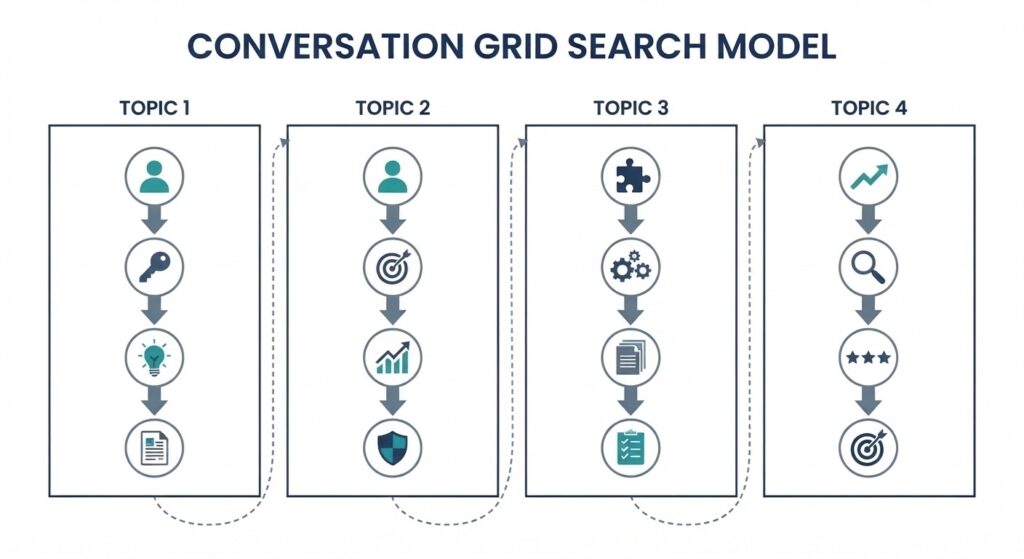
I developed what I call the CSI approach — of course after the TV show (!) thanks to which I discovered the methods crime scene investigators use. If you too are a CSI fan, the visual shows the grid I adapted for conversations. Picture a grid. Each column is a topic. Each question takes you one step deeper into that column. When a thread is exhausted, a lateral move opens the next one.
You build your understanding one topic at a time, systematically, without rushing to conclusions.
You build your own CSI grid.
When you think you’re done, ask the magic question:
Is there any question I didn’t ask that I should have?
Not a rapid-fire interrogation – rather, a genuine, thoughtful inquiry that signals you care.
Two things about getting the CSI approach right: the beginning and the follow-up.
In a meeting, you have your beginning: that point you wish to clarify. You enquire and you drill, gently, not like a sergeant major bullying a new recruit, to illuminate that area of enquiry.
With someone new, perhaps at a networking event, I suggest you think of a few openings in advance.
I personally like to start with the moment.
I call those the “Zero Friction Openers”.
Something like: “What brought you out tonight—was it the speaker, or are you catching up with familiar faces?” The person is soooo relieved that you didn’t ask them: “So, what do you do?”
My favourite: “I’m debating whether the finger food is worth the line – have you tested it yet?”
To join a group: “May I join you? I’m trying to avoid standing by the buffet alone.”
Or: “May I stand next to you for a minute? These large rooms take time to warm up.”
You can use that second one on a perfect stranger too. You will get a laugh. Ice broken.
I prepared all of those. Nothing spontaneous for this anxious introvert.
Now for a few tips for your follow-up and bridging questions:
All these invitations have one common point: they invite storytelling.
The human brain is a sucker for stories. Yes, there is research backing that assertion.
Stories facilitate rapport. From rapport ensues warmth.
What NOT to do:
 Caroline went to her conference.
She prepared her Zero Friction Openers.
She walked her first CSI grid.
She texted me from the event to say she not just eating: she was “actually talking to people!”
Not because she had finally learned to read people.
Because she had stopped trying to.
Reading people accurately, it turns out, means finding out.
Today’s last Relationship Wisdom pivot:
People are not books.
And the ones who understand that — ask.
If something in this article resonated with you, feel free to get in touch.
For how to use the CSI approach with your manager: How to Master that Project Assignment.
#coachingforinspiration #readingpeople #workplacerelationships
[1] Not her real name.
[2] Also not his real name.
Frequently Asked Questions
What does it mean to read people at work?
Reading people at work means understanding what someone wants, how they think, and how they are likely to receive what you say. It is not about decoding body language or spotting micro-expressions — it is about building an accurate picture of the person in front of you, one conversation at a time. That picture is what allows you to influence with ease and position yourself deliberately.
Why am I bad at reading people?
You are probably not bad at reading people — you may simply be using the wrong method. Most of us either project (we assume others think and react as we do) or we give up (we decide we simply cannot read people, and stop trying). Both are limiting beliefs that leave the same gap: an inaccurate picture of the other person. Neither is a talent problem. Both are solvable.
Does body language help you read people?
Partly, and not in the way most people think. Physical cues — including micro-expressions — tell you that something is worth noticing, not what it means. Crossed arms, a clipped tone, a flash of irritation: each is a prompt to find out more, not a conclusion to act on. Culture, neurotype and personality all shape how people express and regulate emotion. Treating a cue as a verdict is itself a form of misreading.
How do you actually read people better?
You ask, and you listen. Specifically, you ask open questions, follow up on what the other person says, and build your understanding one topic at a time without rushing to conclusions. The research is unambiguous: imagining what someone thinks does not improve accuracy. Asking them does. The skill is not observation — it is conversation.