
There’s a particular kind of professional exhaustion that has nothing to do with workload. It shows up as dread before certain meetings, the weight of unresolved tensions, or that persistent sense that you’re working twice as hard for half the recognition. You deliver excellent work yet somehow remain invisible when opportunities arise. You navigate office dynamics carefully yet still find yourself caught in undercurrents you didn’t see coming.
 This is Relationship Friction at work – the hidden force that keeps talented professionals stuck, stressed, and second-guessing themselves. But here’s what most people don’t realise: Relationship Friction isn’t the problem. What is, is the absence of a framework to combat handling it .
You Cannot Thrive: How Relationship Friction Erodes Daily Experience
When Relationship Friction accumulates unchecked, it doesn’t just make work harder – it makes work feel impossible. Every interaction carries hidden weight. You find yourself rehearsing conversations that should be straightforward, analysing every email for subtext, wondering if that colleague’s tone meant something more.
The energy drain is real. Professionals describe spending entire evenings processing a single tense interaction, or lying awake replaying conversations, searching for what went wrong. The actual job – the technical work you’re good at – becomes secondary to the relational chess game you never signed up to play. You’re not just doing your role anymore; you’re constantly managing perceptions, navigating politics, trying to decode unspoken rules that everyone else seems to understand intuitively.
This is what makes Relationship Friction so insidious. It doesn’t announce itself as a crisis. It accumulates quietly through micro-moments: the feedback that felt unnecessarily harsh, the credit that went to someone else, the meeting where your input was overlooked, the project where you did the work but someone else told the story. Each incident alone seems too small to address. Together, they create an atmosphere where you cannot truly thrive.
The cost extends beyond the office. That tension you carry home affects sleep, relationships, health. The irritability that surprises your family. The social events you skip because you have nothing left. The Sunday anxiety that starts earlier each week. Relationship Friction doesn’t stay contained to work hours – it colonises your entire life.
Relationship Friction is the Only Reason Why You Cannot Advance
 But the real tragedy of unchecked Relationship Friction isn’t just daily suffering – it’s the careers it quietly derails. You watch colleagues who seem no more capable advance past you. Promotions feel arbitrary, based on some mysterious formula involving visibility, networking, and knowing how to “play the game” rather than actual performance.
What’s really happening is this: career progression is only partly about technical capability. Rather, career advancement is actually about your relationship skills. Those who progress have learned to metabolise Relationship Friction rather than be paralysed by it. They turn potentially damaging moments into relationship-building opportunities. They know how to disagree without creating enemies, how to be visible without seeming self-promotional, how to manage up without seeming manipulative.
Without this navigational capacity, Relationship Friction compounds into career-limiting patterns. The tendency to avoid difficult conversations means issues fester. The habit of over-functioning to compensate for tension makes you indispensable in your current role but invisible for the next one. The defensive response to feedback signals you’re “not ready” for greater responsibility. The reluctance to engage in office politics means others shape the narrative about your work.
Each career transition amplifies these challenges. Moving from individual contributor to manager requires a complete relational rewiring that technical expertise doesn’t prepare you for. Stepping into senior leadership demands, among others, influence without authority, juggling of competing agendas, and comfort with ambiguity – all skills that Relationship Friction actively erodes if you haven’t learned to work with it.
The Only Effective Counter: Developing Your Relationship Wisdom
This is where Relationship Wisdom becomes essential – not as another soft skill to master, but as a fundamental skillset for professional effectiveness. Where Relationship Friction is the inevitable tension in human systems, Relationship Wisdom is the capacity to work with that tension productively.
Relationship Wisdom isn’t about being liked or avoiding conflict. It’s about, firstly, understanding the hidden mechanics of human interactions and how they manifest in workplace relationships and, secondly, responding with precision rather than reaction. It’s knowing that when your manager seems critical, they might be anxious about their own performance. That when a colleague undermines you, they might feel threatened. That when communication breaks down, it’s usually about misaligned expectations, not malicious intent.
This shift from taking things personally to seeing them systemically changes everything. Suddenly, Relationship Friction becomes information rather than injury. Tension becomes a signal to investigate rather than a threat to defend against. Difficult people become puzzles to solve rather than obstacles to endure.
The Anatomy of Relationship Wisdom
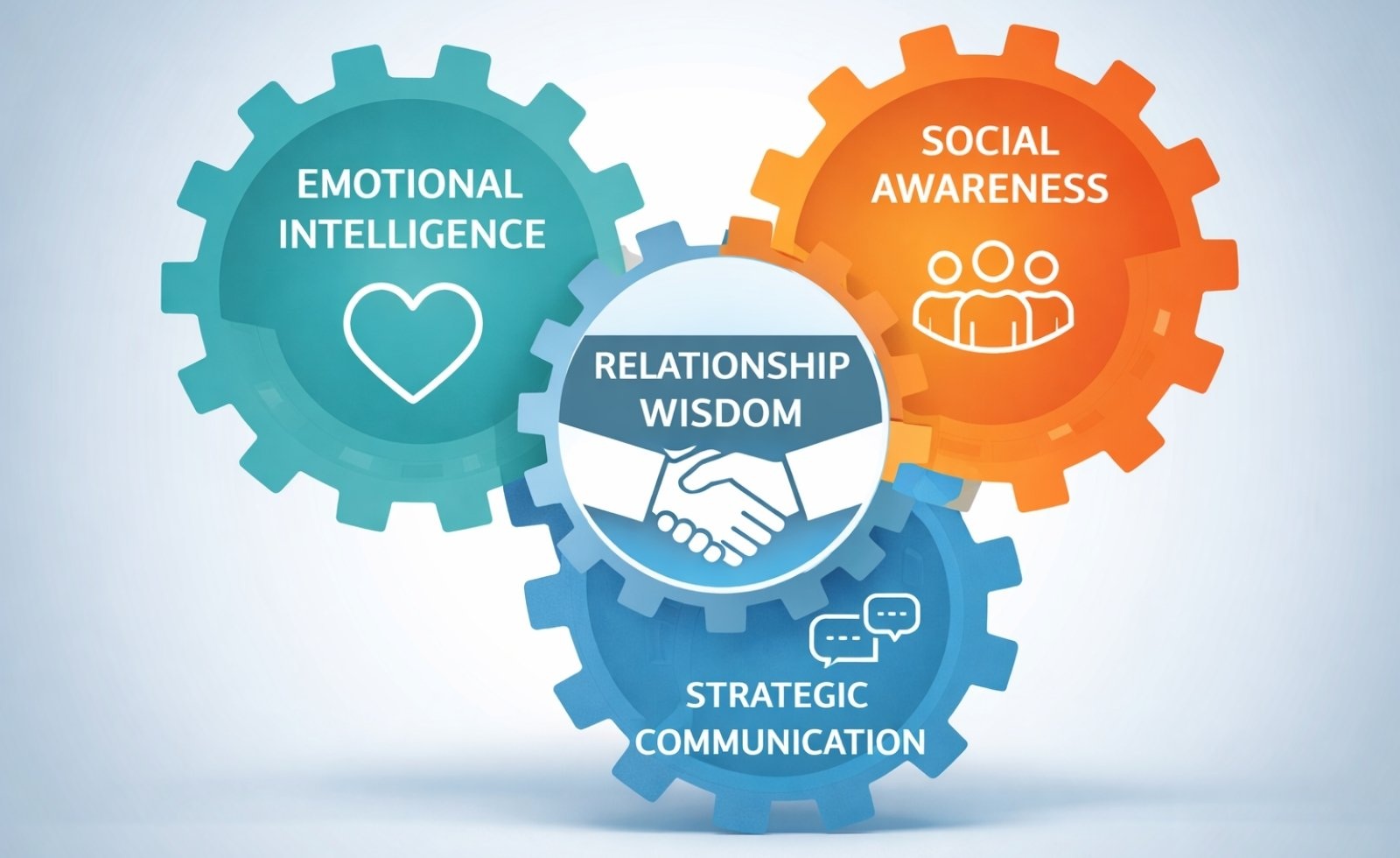
Relationship Wisdom combines the skills of Emotional Intelligence (EQ), Social Awareness, and Strategic Communication, applied to achieve organizational outcomes.
By developing the skills which coalesce into your own Relationship Wisdom, you will become able to (even better) navigate complex social landscapes within an organization.
Emotional Intelligence forms the foundation – the ability to recognise, understand, and manage both your own emotions and those of others. It’s noticing when frustration is clouding your judgment, when someone’s aggression masks insecurity, when team tension stems from unexpressed anxiety. But emotional intelligence alone isn’t enough. You can understand emotions perfectly and still not know how to navigate complex organisational dynamics.
Social Awareness adds the contextual layer – understanding not just individuals but systems. It’s reading the room, recognising power dynamics, understanding how different agendas intersect. It’s knowing that the Finance Director’s pushback isn’t personal but structural, driven by quarterly pressures you hadn’t considered. Social awareness reveals the hidden choreography of organisational life, the unwritten rules that govern who gets heard, how decisions really get made, whose support you need to succeed.
Strategic Communication is where understanding becomes action. It’s not just about being articulate but about calibrating your message to land effectively given the emotional and social context. It’s knowing when directness serves and when it threatens, how to frame difficult feedback so it can be heard, how to build coalitions without seeming political. Strategic communication transforms insight into influence.
Why Partial Solutions Always Fail
Here’s what happens when professionals develop only pieces of this skill set:
Social Awareness + Strategic Communication without Emotional Intelligence creates the polished professional who can navigate politics and communicate strategically but struggles with deeper connections. They’re influential but not trusted. People sense something is missing – the human element at the heart of sincere rapport. Their influence is transactional, effective in the moment but failing to build the lasting alliances that sustain careers over time.
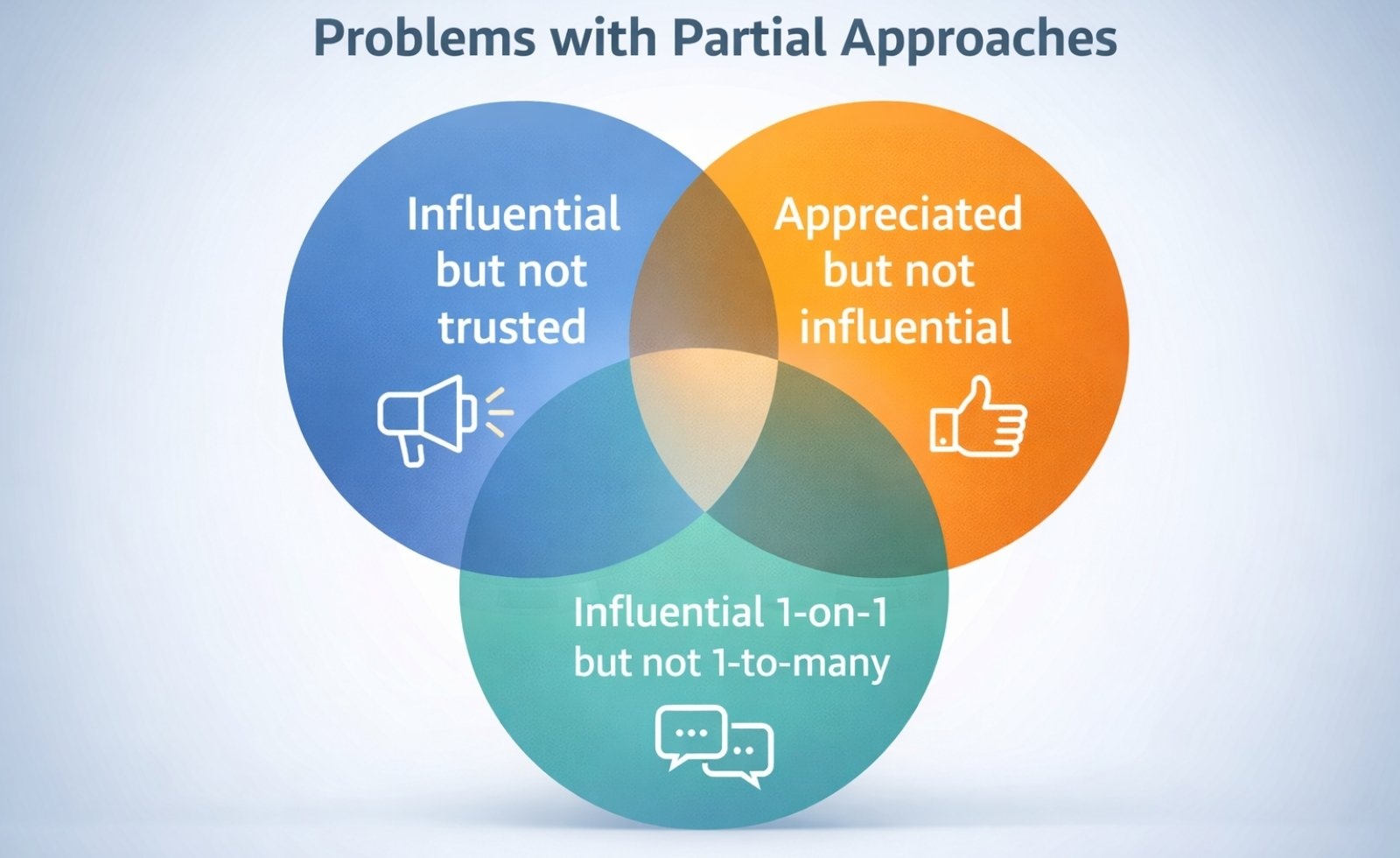 Emotional Intelligence + Social Awareness without Strategic Communication produces the empathetic colleague everyone likes but who can’t translate understanding into impact. They’re appreciated but not influential. They see what needs to happen, understand why people resist, feel the organisational currents – but can’t articulate a path forward that moves people to action. Their insights remain trapped in awareness without agency.
Emotional Intelligence + Strategic Communication without Social Awareness creates someone brilliant in one-on-one interactions who flounders in group dynamics. They can connect deeply with individuals on a 1:1 basis, even communicate with impact, but they can’t see the systemic forces at play. They’re influential one-on-one but not one-to-many. They don’t understand why what works with their manager fails with the leadership team, why their perfectly crafted message lands differently in different forums.
The Holistic Nature of Relationship Wisdom
True Relationship Wisdom emerges only when all three capabilities work together. It’s like learning to drive – you need simultaneous awareness of speed, position, other vehicles, road conditions, and destination. Focusing on one element while ignoring others doesn’t make you a better driver; rather it makes you dangerous in more sophisticated ways.
As you build up the skills that make up Relationship Wisdom, something remarkable happens. You become that person who can deliver difficult feedback that somehow strengthens relationships. Who can navigate politics without becoming political. Who can disagree productively, influence without manipulation, maintain authenticity while adapting to context.
This isn’t about becoming a different person or playing a role. It’s about expanding your relational range while maintaining your core. Your technical expertise doesn’t diminish; it gains a relational vehicle that amplifies its impact. Your authentic self doesn’t disappear; it finds more sophisticated ways to express itself that actually land with others.
Developing the Right Elements at Each Career Stage
The elements of Relationship Wisdom you need most vary as your career evolves. As a Direct Contributor, emotional intelligence matters most – learning to manage your own reactions, read feedback accurately, build trust through reliability. Without this foundation, every interaction feels fraught, every piece of feedback feels like an attack.
Moving into first-time management demands rapid development of social awareness. Suddenly you’re navigating between your team and upper management, balancing competing priorities, understanding how your unit fits into larger organisational dynamics. The individual contributor who thrives through technical excellence alone hits a wall here.
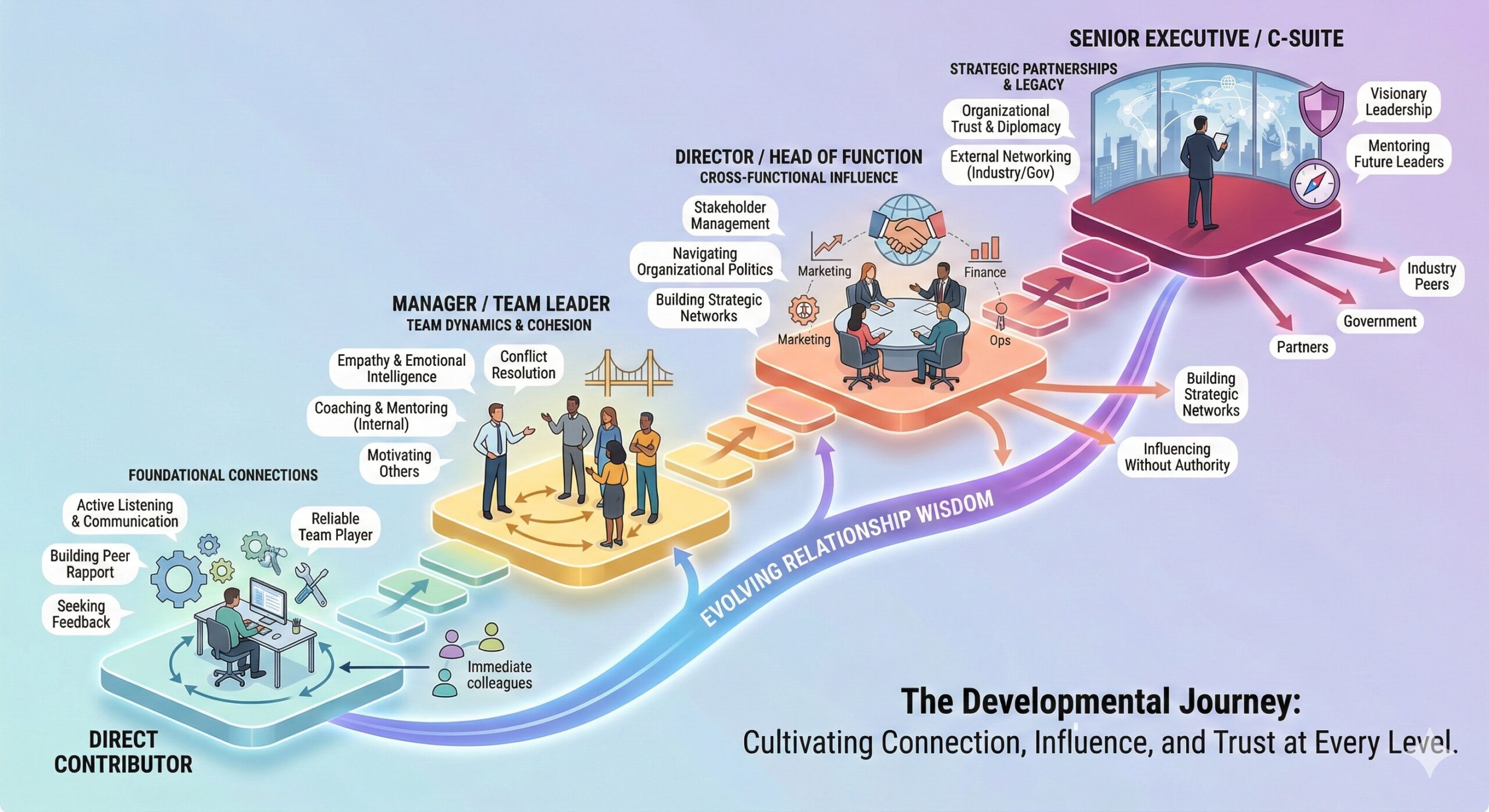 As you progress to managing managers, strategic communication becomes critical. You’re no longer just conveying information but shaping narratives, building coalitions, influencing without direct authority. The communication style that worked when you had five direct reports fails when you’re trying to align multiple teams with different agendas.
As a senior executive, all three elements must operate at sophisticated levels simultaneously. You’re managing complex stakeholder relationships, navigating board dynamics, representing the organisation externally. The margin for error shrinks while the complexity expands exponentially.
But here’s the crucial insight: you can’t skip stages. Trying to develop strategic communication without emotional intelligence creates hollow messaging that people see through. Attempting social awareness without emotional grounding leads to paralysis – you see all the dynamics but feel overwhelmed by them and thus paralyzed into muteness. Each relational capability builds on and reinforces the others in a fluid developmental sequence.
Each career stage can be divided into crucial career moments. For example, as a Direct Contributor, such a career moment is when you are given a task by your manager. A conversation rife with Relationship Friction pitfalls. Or how about when you have to let your manager know you are running behind and might not meet the assigned deadline. Or that conversation when your manager gives you feedback and you find out about how you really did. The list is longer. And there is a list for each career stage and its crucial moments.
No wonder Relationship Friction is so endemic. It has multiple, frequent opportunities to manifest. Thankfully, Relationship Wisdom can save the day. Every day.
The Path Forward: From Relationship Friction to Relationship Wisdom
The professionals who transform their careers aren’t the ones who encounter less Relationship Friction – they’re the ones who steadily develop their Relationship Wisdom one step at a time to effectively combat the Relationship Friction they’re confronted. They stop asking “Why is this happening to me?” and start asking “What is this teaching me about the system I’m operating in?”
This shift doesn’t happen overnight. Relationship Wisdom develops through deliberate practice, honest feedback, and often uncomfortable experimentation. It requires examining your own patterns, challenging your assumptions, gradually expanding your relational repertoire. Most importantly, it requires accepting that Relationship Friction isn’t a flaw in the system or within yourself – it’s the raw material from which Relationship Wisdom emerges.
You build your own brand of Relationship Wisdom by acquiring relationship skills such as active listening, non-violent communication, process language, strategic silence, negotiation, influence, empathising, assertiveness, conflict management and reframing. Each career stage requires a certain package of relationship skills. You acquire one skill pack one after the other. At every career stage, you acquire those Relationship Wisdom skills you lack and refine those you already have. The process involves learning, refining and practicing.
The journey typically begins with a catalyst – feedback that stings, a promotion denied, a relationship breakdown that can’t be ignored. This creates openness to seeing patterns differently. With support and structure, what seemed like personal failings reveal themselves as systemic dynamics anyone would struggle with. Seeing Relationship Friction is the first step.
As understanding deepens, agency increases. You learn about and then implement Relationship Wisdom skills. As a result, you start making different choices, small at first – pausing before reacting, asking clarifying questions, reframing situations. These micro-changes create different responses from others, which reinforces your new approach. Gradually, what felt forced becomes natural. You develop your own Relationship Wisdom, one that reflects both your personality and your work context.
Beyond Individual Success
When professionals develop their own Relationship Wisdom, something unexpected happens: they don’t just advance their own careers, they improve the systems they operate in. They become the managers who develop others effectively, the leaders who can hold complexity without becoming rigid, the colleagues who make collaboration work easily.
This ripple effect matters because the organisational dysfunction which is the result of Relationship Friction isn’t just about single individuals bickering: it is about overall structures and processes. Every professional who develops Relationship Wisdom raises the relational intelligence of their environment. They model what’s possible when Relationship Friction becomes fuel for growth rather than cause for withdrawal.
In this sense, developing Relationship Wisdom isn’t just about personal development and furthering one’s own career advancement – it’s also a form of organisational development. It’s how workplace cultures can evolve from fear- to trust-based, from political to productive, from draining to energising.
The Essential Choice
The question isn’t whether you’ll encounter Relationship Friction in your career – you will, repeatedly, at every stage. The question is whether you’ll develop the Relationship Wisdom to transform it into fuel for growth. Relationship Wisdom will allow you to thrive in the career stage you’re in. You can then choose whether you’d like to advance to the next career stage. If you do, chances are that you will need to demonstrate some of the key relationship skills required for that next career stage before you can promoted to it.
 For those feeling stuck despite their competence, exhausted by dynamics they can’t quite name, confused by the invisible rules that govern advancement – the concept of Relationship Wisdom offers both explanation and pathway. The exhaustion isn’t weakness; it’s the natural result of navigating complex dynamics without the proper skillset. Your confusion isn’t revealing any incompetence; rather, it’s what happens when you’re operating with partial tools in a system that requires the full set.
Developing Relationship Wisdom isn’t about becoming someone you’re not. It’s about becoming more skillful about who you are, more deliberate in how you show up and engage, more sophisticated in how you navigate complexity while maintaining authenticity.
The choice is clear: continue struggling with Relationship Friction using incomplete approaches that provide temporary relief but no lasting change or commit to developing your own Relationship Wisdom that transforms not just how you work, but how work feels.
Because on the other side of this development lies something precious: the ability to thrive at every stage of your career journey, to advance when you choose to, to sleep soundly knowing you can handle whatever relational complexity tomorrow brings. Not because Relationship Friction disappears, but because you’ve developed the Relationship Wisdom to work with it productively.
The invitation is simple but not easy: stop fighting Relationship Friction and start learning from it. Stop seeing relational challenges as verdicts on your worth and start seeing them as data about dynamics. Stop trying to survive workplace relationships and start developing the wisdom to thrive within them.
If you want to fight, then know that Relationship Wisdom is how you combat Relationship Friction.
Your Relationship Wisdom journey awaits.
If you’d like to share some of your Relationship Friction challenges, click here.
If you’re interested in discussing building your unique brand of Relationship Wisdom, click there.